The gaze
A woman whose beauty belongs to everyone except herself.
A Gothic novel · Lex Bejar
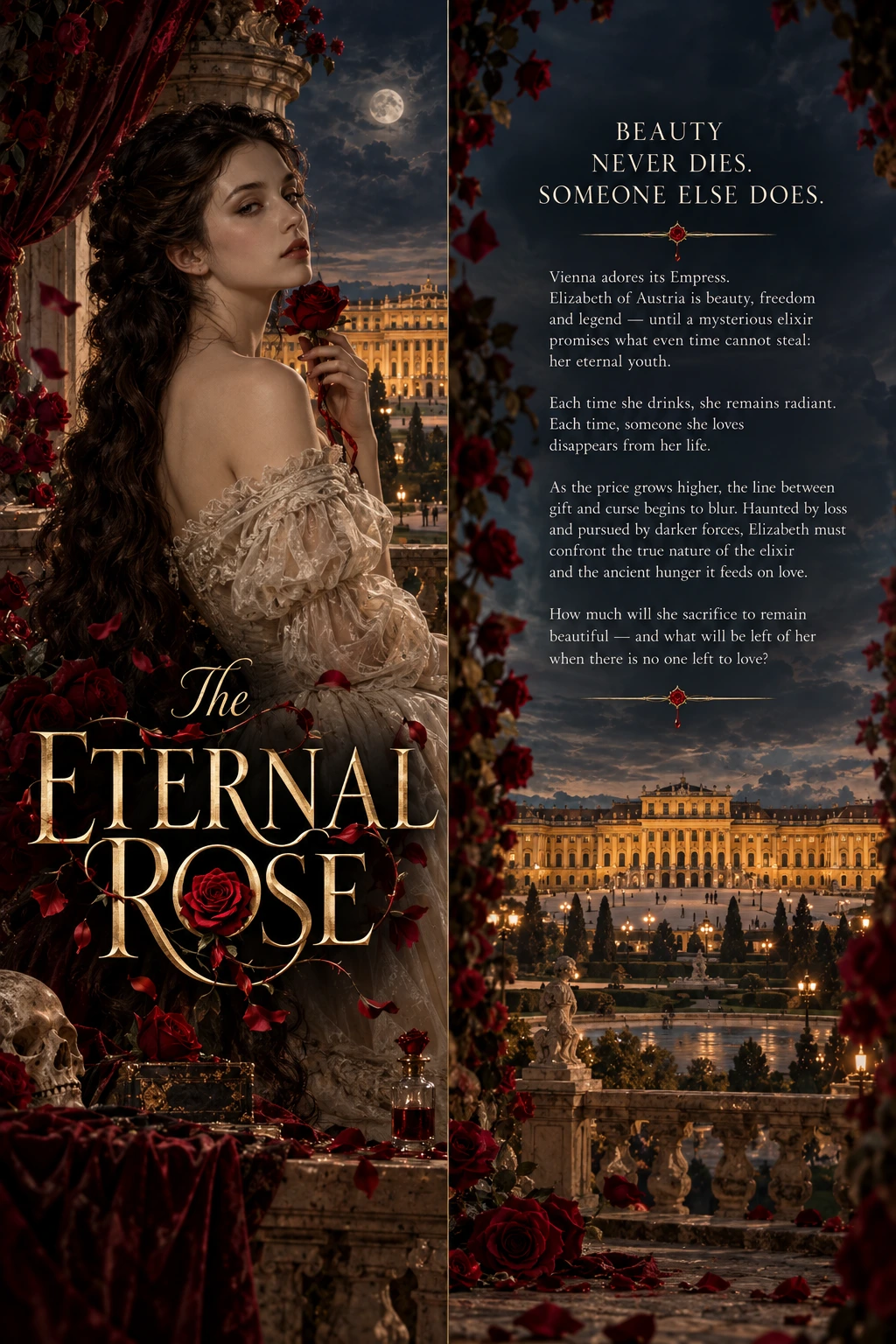
Beauty never dies.
Someone else does.
An empress adored by an empire. A gift that holds back time. A debt collected from everyone she loves.
Read the prologueDiscover the storyFollow on InstagramImperial splendour. Intimate horror.

The story
Elisabeth of Austria lives beneath the gaze of an empire. Every appearance is measured. Every change in her beauty becomes public property.
A mysterious gift promises what neither rank nor riches can secure: youth that endures. But each time she drinks, someone she loves is taken from her.
As loss gathers around her, Elisabeth must confront the hunger behind the gift—and the terrible possibility that her most private affections have become a ledger.
How much of a life can she surrender
to preserve its reflection?
From the prologue
“She had been fond of him. She had not known until this moment how fond.”Buda, June 1867
The song of the novel
The English version of the song inspired by the novel.
A moment from the prologue
Elisabeth walks through the royal gallery. In the mirrors, something falls out of step.
Behind the crown
The novel moves from the frozen lake at Possenhofen to the court of Vienna and the coronation celebrations in Buda. Beneath its candles, silk and ceremony, a darker history unfolds.
A woman whose beauty belongs to everyone except herself.
A small vial. A single red drop. A promise that never names its full price.
A hunger that finds love, even when she has not admitted it to herself.
A supernatural reimagining of the life of Empress Elisabeth of Austria.
The Royal Palace, Budapest
Enter the novel
Buda, June 1867
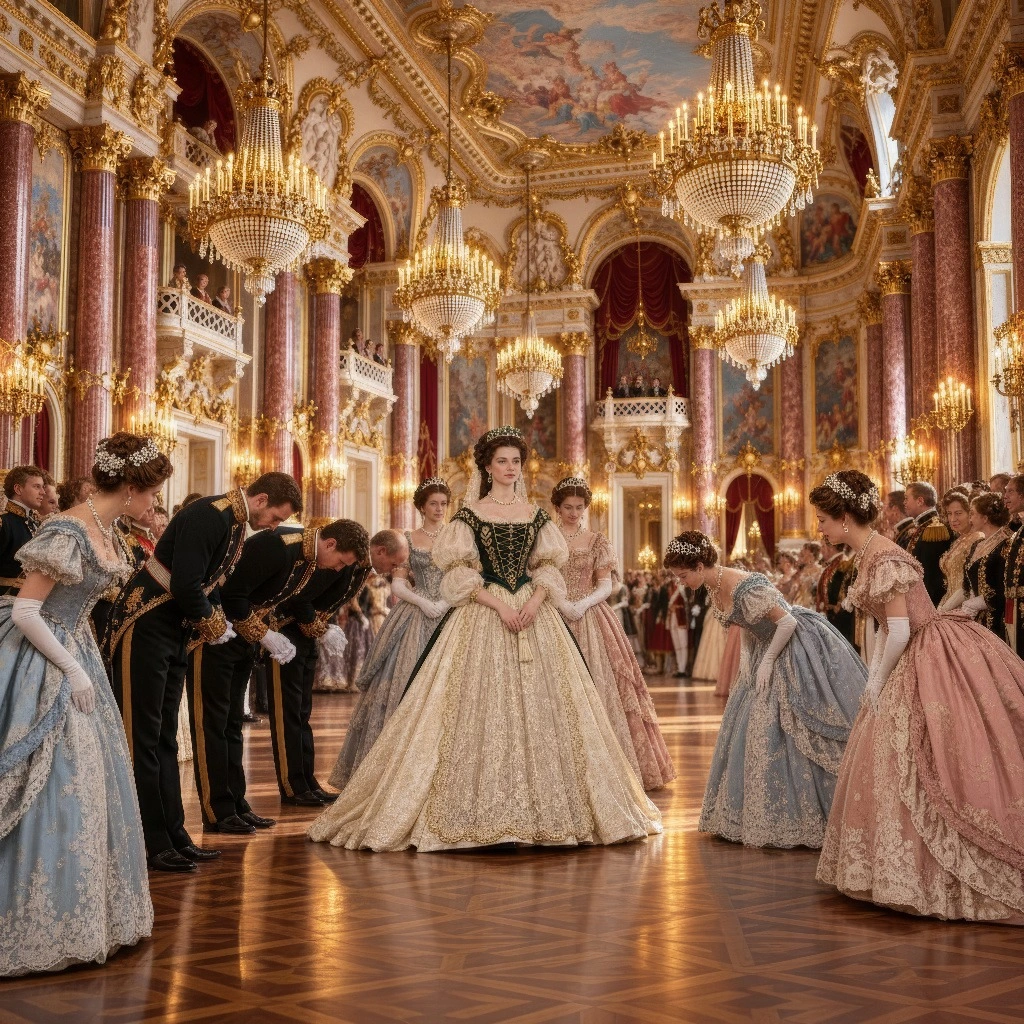
The chandeliers of the royal palace held a thousand candles each, and the mirrors along the walls multiplied them until the ballroom seemed to stand inside a slow fire. Wax dripped onto the parquet where the footmen could not reach, and the ladies stepped around it without looking down, as they had been taught to step around anything unpleasant.
They had been waiting since nine. It was past eleven.
This was the third night of celebration since the coronation. Bonfires still burned on the hills across the river, and in the streets below the palace students sang songs that had been forbidden a year ago. Inside, the magnates of Hungary stood in their ancestral costume, fur-trimmed fabrics over one shoulder, jeweled swords at their hips, sweating through their silk. No one would leave before she came.
The king had already gone back to Vienna, and hardly anyone remarked on it. They had come to see the queen.
The silver clock above the staircase struck the half hour. The chamberlain brought his staff down three times, and the room went quiet from the doors inward, like a field going still before rain.
"Her Majesty Elisabeth, Empress of Austria, Apostolic Queen of Hungary, Queen of Bohemia, of Dalmatia, of Illyria, of Croatia…"
The titles went on. Somewhere around Illyria, a young baroness began counting them on her fingers and was pinched by her mother.
Then the doors opened.
She came in alone, in the Hungarian fashion. Ivory silk brocade worked all over in gold, the skirt so wide and heavy that it moved over the parquet like a slow tide. A bodice of bottle-green velvet, laced across the front with gold cord in the old Hungarian manner, the cord's long tassel falling down the front of her skirt. White gauze sleeves gathered into clouds at the shoulder. Pearls at her throat. Her hair coiled high under a small crown of emeralds, so that the long white neck showed above the velvet. Her waist could have been circled by a man's two hands. People said this so often that it had stopped sounding like a compliment and started sounding like a rumor, and here it was, true, walking toward them.
Four hundred people drew in their breath at once.
She would be thirty in December. She had been married thirteen years and borne three children, and one of them had been ten years in the ground. None of it showed. The older women along the walls looked at her and then, without meaning to, at their own reflections, and pressed their lips together. The young ones watched her half afraid. They had been told all their lives that beauty was a season. Here was a woman who seemed to have been excused from the calendar.
Elisabeth felt every one of those looks, as a sailor feels weather. At sixteen they had nearly crushed her. Now she walked through them and let them break.
Beneath the kid leather of her right glove, pressed against her palm, lay a vial no longer than her smallest finger, carved from something pale that was not ivory. Inside it hung a single drop of red.
It moved. It always moved. Tonight it moved slowly and heavily, like a cat that has been fed.
Two days ago, in the Matthias Church, while the Bishop of Veszprém held the Holy Crown of St. Stephen above her right shoulder, the lady behind her had made a small sound. Afterward in the sacristy her hairdresser, Fanny, come to repair what the crown had disturbed, had found it with steady fingers and shown it to her in a hand mirror: one hair, white as a thread of frost, among the dark ones at her temple.
She had not cried. She had waited until the palace was asleep.
She could still taste it: iron and honey, roses crushed in the fist, and under that something that belonged in a vault. When the fever of it burned out the white hair was dark again, the line that had begun to settle beside her mouth was gone, and she had the girl's waist back.
Ten and a half years since the first time. She had sworn there would never be a second.
Now the book was open again. Somewhere a name was being written. She would not know whose until it was paid.
✦
Count Andrássy reached her first, in the leopard pelt of a Magyar noble of the old kind, his dark handsome face flushed with triumph. A year ago the Emperor's ministers had called him a traitor. Tonight he was Prime Minister of Hungary.
He bent over her gloved hand, and through leather and skin and bone she felt the drop turn toward him like a flower toward a window. She withdrew her hand.
"They are saying in the coffeehouses that the Queen crowned the King," he said, "and not the other way around. His Majesty was sorry not to stay."
"His Majesty is always sorry," Elisabeth said, and heard how it sounded, and let it stand.
Franz would be at his desk in Vienna tomorrow before five, under a green-shaded lamp. He had been kind to her, in the way he understood kindness. Fourteen years ago a man had driven a knife into the back of his neck, and he had walked away with a torn collar. Since then he had never been ill with anything worse than a cold.
She did not know why that thought came to her now, or why it came so cold.
✦
Near midnight an old magnate with a white moustache and a chest full of orders rose at one of the long tables, a little drunk and happy, and toasted the King, and the Queen twice, and then, because the evening had made him love the whole dynasty, raised his glass once more.
"And to His Majesty's brother, the Emperor Maximilian, across the sea. May God keep him safe in Mexico."
Some of the room drank. Some did not. The news from Mexico had been bad for months.
In Elisabeth's glove, the vial grew warm.
A small warmth, no more than a coin held in the hand. She set her glass down on the arm of her chair carefully, so that it would not tip.
Max. Gentle Max, with his botanist's hands, who had walked with her once in the gardens at Miramare naming every plant in Latin and then in Spanish, laughing at his own accent, who had written to her from Mexico about hummingbirds. She had been fond of him. She had not known until this moment how fond.
It finds what is there, she thought, whatever you have told yourself.
She rose and crossed toward the long gallery where the air was cooler, and the mirrors walked beside her, a hundred Elisabeths in ivory and green and gold, moving in step.
One of them was half a pace behind. And beside it, at the height of her hip, stood a small blur of white: a little girl in a white dress, holding up her hand to be taken.
Elisabeth stopped. The glass showed only the gallery, the candles, and herself.
Behind her the csárdás quickened. Across the black river the bonfires burned on the Pest side, and the whole city glittered as if it had been dipped in gold.
She laid her gloved hand flat against the cool mirror and closed her eyes, and let memory take her down, past Madeira and the field hospitals and the little coffin in Buda, past the first drink and the wedding and the stranger with frost on his cloak.
All the way down to a winter morning at Possenhofen when she was fifteen, and a letter came from Vienna saying that a man had tried to stab the young Emperor in the neck, and the collar of his uniform had stopped the blade.
The author

The Eternal Rose brings the splendour of the imperial court into a story of beauty, grief and the cost of refusing time.